Community Violence Intervention
People, partnerships, and stable capacity for violence interruption, outreach, and healing-centered support.
The Rehoboth Project · Framework
Durable Safety is a civic framework for aligning the systems people rely on. It helps communities and institutions see what is working, where gaps remain, and how to set shared priorities that can sustain safety over time.
“Programs may interrupt violence. Only aligned civic systems can sustain peace.”Power Lab · Juard M. Barnes
The framework
Each pillar has a distinct role. Durable Safety asks how well each one functions—and whether the systems connect around what residents need.
People, partnerships, and stable capacity for violence interruption, outreach, and healing-centered support.
Public systems accountable to the safety residents need, with shared direction across institutions and neighborhoods.
Care and recovery connected across clinical and community settings, including effective referral pathways.
Pathways to material stability, employment, and shared opportunity that strengthen community well-being.
Relationships, learning, and meaningful room for young people to grow, contribute, and lead.
Moral voice, trusted relationships, and public responsibility brought into the work of building safety.
Resident participation and leadership with the ability to influence public decisions and shape shared priorities.
Support and connection through reentry, with attention to stability, opportunity, and community belonging.
One civic ecosystem
The framework places Civic Power and Community Agency at the center. The goal is not to collapse every system into one program; it is to build relationships, shared direction, and dependable pathways across them.
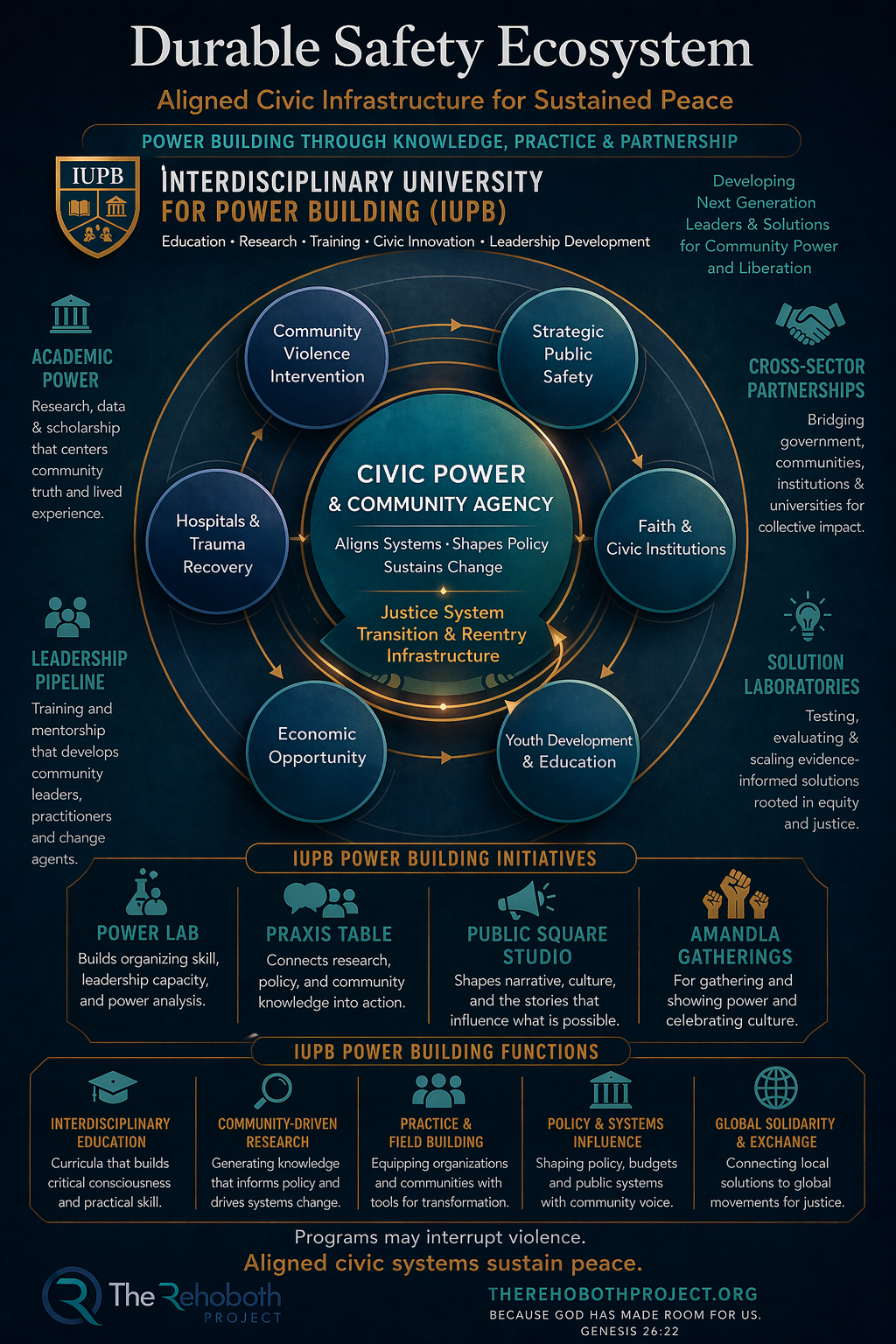
Communities can begin with faith assets, resident leadership, CVI, health, education, or another local strength. The work is to connect those assets to partners and public systems around shared needs and locally defined priorities.
Alignment is practical: stronger referrals, shared planning, stable relationships, clear accountability, and the ability to act together when conditions change.
A learning and assessment tool
The Index offers a structured way to examine each pillar across four dimensions. It is designed to inform local learning and action, not reduce a community to a single number.
Can the pillar function? Consider staffing, resources, operational maturity, and funding stability.
Who can reach it? Examine geographic coverage, demographic reach, and equitable access.
How well does it perform? Consider standards, training, evidence-informed practice, and consistency.
How well does it connect? Examine referrals, shared strategies, data, and joint planning.
Alignment is the multiplier. A cross-pillar reading considers shared planning, data coordination, cross-sector leadership, and policy and budget alignment. Strong systems working in isolation can remain fragile.
A sequenced process
A useful assessment begins by asking whether a community is ready to assess—and able to act on what it learns.
Review leadership alignment, existing safety assets, coordination, community trust, data, and capacity to act. When conditions are not ready, establish a focused readiness pathway first.
When ready, assess capacity, access, quality, and integration using available evidence and local knowledge. Residents, practitioners, and cross-sector partners help validate findings.
Set priorities, align leadership and resources, and build a practical path for implementation, learning, and sustained accountability.
TRP can facilitate a readiness scan and lead a full assessment with local partners. The work is collaborative: findings and next steps are shaped with the people and institutions closest to the issues.
Read the framework
The full paper sets out the eight-pillar framework, the Index, the roadmap, and operating practices for connecting systems over time. Its composite score bands are developmental guidance; they should not be used to rank cities or make direct cross-city comparisons.
Open the field paperTalk with The Rehoboth Project